
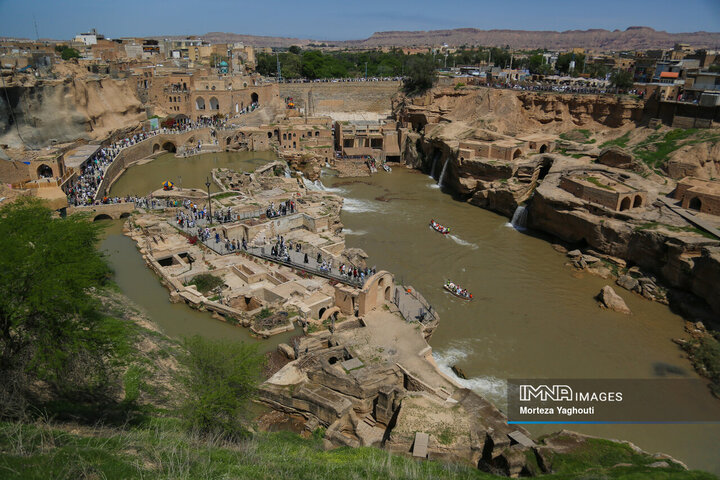
Iran (IMNA) - Speaking after ceremonies marking Iran’s Cultural Heritage Week, Atefeh Rashnoei, director of the Shushtar World Heritage base, described the southwestern Iranian city as “a living civilizational system” rather than simply a historical urban center. She stressed that the future prosperity of Shushtar depends not only on preserving its monuments but also on maintaining the cultural vitality that has defined the city throughout its history.
“Cultural Heritage Week has ended, but the glory of Shushtar’s name, under the shadow of its world heritage, shines brighter than ever,” Rashnoei said. “The survival of this ancient city is tied not only to its architectural structures, but also to the living culture flowing through this land.”
She praised the extensive cooperation among cultural activists, local officials, investors and academics during the heritage celebrations, describing it as unprecedented. According to Rashnoei, strategic support from provincial authorities and Khuzestan’s Cultural Heritage, Tourism and Handicrafts Department facilitated a wide range of cultural programs and created a foundation for future development projects.
Rashnoei also highlighted the central role of local residents in preserving the city’s identity and historical legacy. “The people of Shushtar are the true guardians of this ancient land,” she said, adding that recent initiatives mark “the beginning of a major path toward recreating our urban identity.”
The official said efforts are underway to transform Shushtar into an international model demonstrating how heritage conservation can be combined with economic growth and cultural advancement.
Located in Khuzestan Province, the Shushtar Historical Hydraulic System was inscribed on UNESCO’s World Heritage List in 2009 as “a masterpiece of creative genius.” Parts of the vast hydraulic complex date back to the reign of Darius the Great in the fifth century BC, making it one of the most sophisticated water management systems of the ancient world.
The system reached its current form during the Sasanian era in the third century CE and includes an extensive network of dams, bridges, canals, tunnels, mills and irrigation facilities designed to regulate and distribute water from the Karun River. UNESCO has recognized the site for both its engineering achievements and its multiple functions, including urban water supply, agriculture, transportation and defense.
Among the complex’s most notable structures is the Shadorvan bridge-dam, historically regarded as one of the wonders of the ancient world. The Gargar canal, an artificial waterway built to irrigate surrounding lands and support urban expansion, remains one of the defining features of the system.
Historians believe the hydraulic network reflects a combination of Elamite, Mesopotamian and Roman engineering traditions, demonstrating centuries of technological exchange across the ancient Near East.
Today, the historic hydraulic structures remain an integral part of Shushtar’s urban and rural landscape, continuing to shape the city’s identity while supporting its tourism-driven economy.
Tehrantimes
Your Comment