
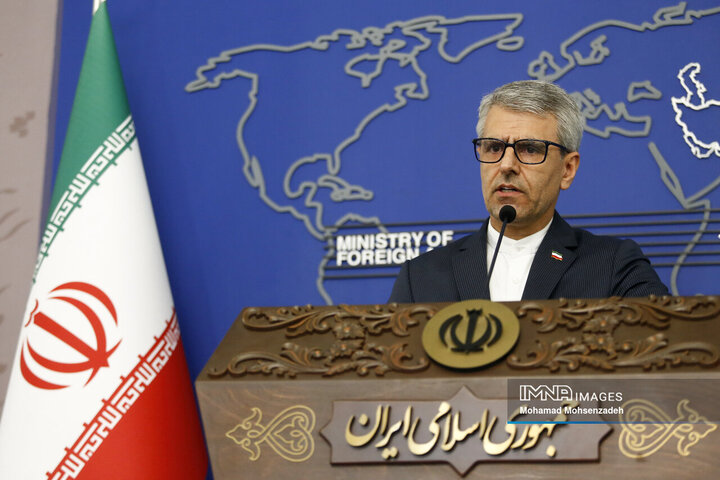
Iran (IMNA) - Baghaei stated that the US and E3’s attempt to trigger the so-called snapback mechanism to re-impose UN sanctions represents an endorsement of an international criminal act, stressing that such political statements cannot lend legitimacy to illegal measures.
Criticizing the G7 for urging Iran to continue cooperation with the International Atomic Energy Agency (IAEA), he highlighted the group’s failure to address the joint actions taken by the US and Israel in targeting Iran’s nuclear facilities. He held Washington primarily responsible for the current state of Iran’s nuclear program due to its 2018 withdrawal from the Joint Comprehensive Plan of Action (JCPOA) and subsequent military attacks against Iran.
“Fundamentally, the United States is the main cause of the current situation due to its illegal and unilateral withdrawal from the JCPOA in 2018 and military attacks on Iran's peaceful nuclear facilities,” Baghaei said.
On May 8, 2018, former US president Donald Trump announced Washington’s unilateral exit from the nuclear deal, despite Iran’s voluntary acceptance of specific restrictions on its nuclear activities in return for sanctions relief. Trump labeled the JCPOA “the worst deal in history,” vowing to secure a “better deal” that would include Iran’s ballistic missile program and regional policies—issues that Iran has consistently declared as redlines. His withdrawal marked the beginning of the so-called “maximum pressure” campaign aimed at forcing Iran into renegotiation.
While Russia, China, Britain, France, and Germany expressed regret over the US decision, some failed to take concrete steps to fulfill their commitments. Over the decade that followed, the US withdrawal, combined with unmet obligations and a sustained pressure strategy, ultimately caused the collapse of the JCPOA.
In his remarks, Baghaei also condemned the unlawful military actions carried out by both the Zionist regime and the United States against Iran’s peaceful nuclear facilities. He described the G7’s call for Iran to cooperate with the IAEA—while ignoring these acts—as “deceitful and interventionist.”
He further criticized the three European parties to the JCPOA for aligning with Washington and failing to uphold their commitments, arguing that they not only violated the agreement but also dismissed Iran’s diplomatic initiatives.
Baghaei went on to denounce the G7’s position on the Palestinian issue, calling it irresponsible and inconsistent with their international obligations to defend the right to self-determination and prevent genocide. He said the unconditional backing of the United States and other G7 members for the Zionist regime has stripped the group’s human rights claims of any credibility.
The spokesman also rejected the G7’s repeated accusations regarding Iran’s alleged role in the Ukraine conflict, reaffirming the Islamic Republic’s principled opposition to war and its advocacy for dialogue and diplomacy. He emphasized that Iran does not interfere in the conflict and urged those leveling accusations to correct their own policies concerning global peace and security instead of perpetuating a narrative of “self-supremacy” and “blaming others.”
Your Comment