
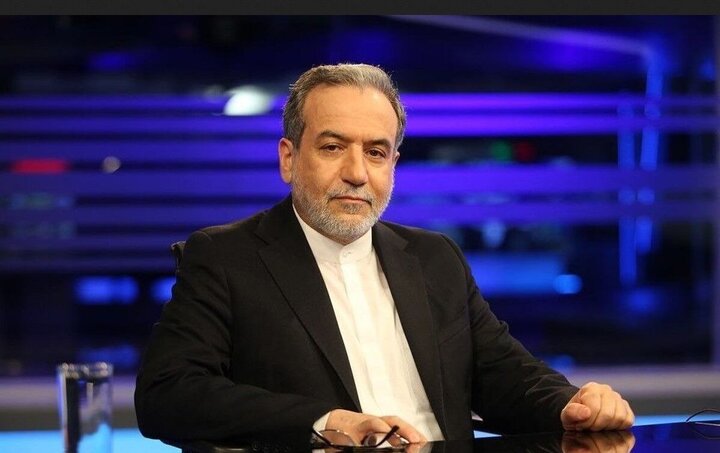
Iran (IMNA) - Speaking in a televised interview on Saturday night, Araghchi addressed multiple regional and diplomatic issues, including the Gaza ceasefire, the Abraham Accords, and ongoing disputes with the United States and European powers over the nuclear file.
The foreign minister reaffirmed Iran’s support for any plan that ends the genocide in Gaza, stressing that Tehran has repeatedly called in international forums for decisive global action to stop the crimes committed by the Zionist regime. “There is no trust in the Zionist regime,” he said, adding that Iran has issued the necessary warnings and will continue to do so.
According to Araghchi, the first phase of the Gaza ceasefire has been implemented, but more than half of Gaza remains under occupation, casting doubt on Israel’s willingness to fully withdraw. “Our stance is not moderate but realistic,” he said, emphasizing that Iran supports halting the genocide, delivering humanitarian aid, and guaranteeing the rights of the Palestinian people.
On the interpretation of Tehran’s position by former U.S. president Donald Trump, Araghchi clarified that no negotiations or messages have been exchanged with the United States. “At various times, Washington tried to link unrelated issues together, but we have always stated clearly that Iran’s talks are limited to the nuclear issue and never involve topics such as resistance movements,” he said.
Referring to Trump’s recent remarks suggesting Iran could join the Abraham Accords, Araghchi rejected the notion, calling the accords “fundamentally treacherous” and incompatible with the ideals of the Islamic Revolution. “Such an event will never happen,” he asserted.
Araghchi criticized the inconsistency of U.S. policies, saying that both the Trump and Biden administrations have repeatedly shifted their positions. He expressed doubt about American commitments regarding Gaza and nuclear issues, citing skepticism shared by regional officials.
Addressing the snapback mechanism and messages from European countries, Araghchi reiterated that Iran does not accept a comprehensive agreement because no comprehensive negotiations have taken place. “Negotiations will only concern Iran’s nuclear program,” he said, questioning why the three European countries — Britain, France, and Germany — seek new talks after violating their commitments under the 2015 nuclear deal.
“We see no grounds for negotiation with these three countries,” he continued. “The concept of a ‘trioka’ is no longer relevant. We will manage our relations with European states based solely on Iran’s interests.”
Responding to reports of contact with U.S. envoy Brett McGurk (Witkoff), Araghchi rejected claims of a phone conversation, saying only messages through intermediaries have been exchanged. He revealed that the U.S. demanded Iran hand over its 60% enriched uranium in exchange for a six-month suspension of the snapback, a proposal Tehran deemed excessive, causing the New York talks to fail.
He added that during those negotiations, Iran implemented the Cairo agreement and presented “reasonable proposals,” which even French President Emmanuel Macron described as fair. “We did everything possible without compromising our national interests,” Araghchi said.
The top diplomat stressed that if Washington wishes to resume negotiations, it must present balanced and logical proposals based on mutual respect. “We will not relinquish our enrichment rights,” he underlined, “but if the other side respects our rights and offers balanced proposals, we are ready to review them.”
Referring to cooperation with the IAEA, Araghchi noted that the Cairo agreement is currently suspended due to European actions but added that the Tehran Research Reactor continues its production of isotopes and nuclear medicine under the Agency’s supervision. “Any IAEA request will be reviewed by the Supreme National Security Council,” he said.
Concluding his remarks, Araghchi reiterated that no negotiations are currently taking place with the Americans, but if a fair and balanced proposal arises that safeguards the Iranian people’s interests, “Tehran will certainly examine it.”
Your Comment