
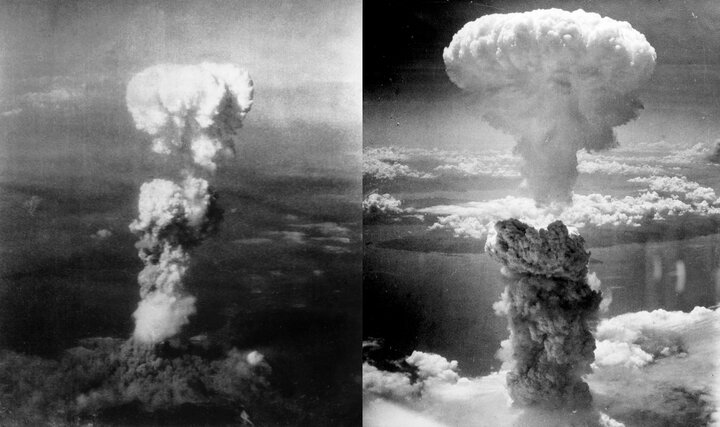
Iran (IMNA) - On August 6 and August 9, 1945, with the consent of the United Kingdom under the Quebec Agreement, the US armed forces carried out history's first and only use of nuclear bombs in war, targeting the Japanese cities of Hiroshima and Nagasaki. Orders for these attacks were issued by General Thomas T. Handy, the acting chief of staff of the US Army, choosing Hiroshima, Kokura, Niigata, and Nagasaki for their urban and military significance.
The atomic bomb detonated over Hiroshima at 08:15 local time—a uranium device nicknamed "Little Boy"—yielded the explosive power of about 15,000 tons of TNT. This bomb destroyed 70% of Hiroshima’s buildings, causing a firestorm and near-instant annihilation for tens of thousands. The blast and its aftermath led to an estimated 140,000 deaths in Hiroshima by the end of 1945, with roughly half those deaths occurring on the first day; Nagasaki saw 74,000 fatalities by the year’s end. It is estimated that 38,000 of those killed were children.
Despite Hiroshima’s sizable military garrison (about 24,000 troops), some 90% of the victims in Hiroshima were civilians. Ground temperatures in the epicenter soared to 4,000°C, and "black rain" contaminated wide areas with radioactive particles, leading to illness and chronic suffering for survivors.
Survivors faced not just immediate injuries and destruction, but also leukemia, cancer, and other long-lasting effects of radiation exposure. For months after, many continued to die from burns, radiation sickness, illness, and malnutrition.
The anniversary of the Hiroshima bombing is now observed every year at the Peace Memorial Park in central Hiroshima, with residents across Japan observing a minute of silence at 08:15—the moment the bomb fell. This annual memorial reflects on the immense devastation and reinforces the urgent need for peace in a nuclear-armed world.
The Hiroshima and Nagasaki bombings killed and maimed hundreds of thousands and reshaped global history, underscoring the catastrophic human costs of nuclear weapons and serving as a warning for generations to come.
Your Comment