

Speaking to the Islamic Republic News Agency (IRNA) on Monday, Hadipour highlighted the international significance of the Chehel Sotoun palace and garden complex and emphasized UNESCO’s responsibilities toward properties inscribed on the World Heritage List.
He said UNESCO’s obligations extend beyond conservation and restoration to providing support when cultural heritage sites are affected by disasters and armed conflicts.
The organization is expected to help safeguard these monuments against various threats, he added, noting that the Chehel Sotoun management team and the Ministry of Cultural Heritage, Tourism and Handicrafts have been pursuing available international protection and conservation mechanisms.
Emergency measures completed, major repairs still pending
Hadipour said emergency interventions had so far been carried out in two areas: structural stabilization and decorative conservation.
A substantial portion of the immediate risk-reduction work has been completed to prevent further deterioration and secondary damage. These measures have included covering vulnerable sections with plastic sheeting, installing temporary supports, and treating certain doors and pieces of equipment with oil to protect them through the winter.
Specialists have also carried out reinforcement work on the palace’s double-roof structure, he said.
However, technical assessments have identified significant structural concerns, particularly involving the columns of the palace’s porch.

According to inspections conducted by experts from the Ministry of Cultural Heritage and the Chehel Sotoun technical team, some columns have shifted away from their original alignment under substantial loads. Several structural beams have also moved out of their normal positions.
A consulting engineering firm is conducting detailed studies to determine the most appropriate restoration method. Options under consideration include reinforcing the affected columns with steel and returning them to their original alignment, or stabilizing them through engineering measures while retaining their current inclination. Hadipour said no final decision had yet been reached.
Earlier surveys and restoration studies conducted by the consulting engineering firm Emarat-e Khorshid confirmed the columns’ deviation and damage to the rear wall on the southern side of the palace. Technical investigations also identified cracks in the upper beams and horizontal beams beneath the roof trusses in the double-roof structure.
Heavy roofing materials add to structural pressure
The weight of newer brick coverings used in parts of the double roof is another concern, Hadipour said.
Although the brickwork appears more consistent with traditional architectural styles, its considerable weight has placed additional pressure on the supporting columns. A final technical decision is needed on whether and how these materials should be lightened to reduce the structural load.
The findings underscore the need to balance architectural authenticity with the long-term stability of the historic structure.
Damage estimated at 1.5 trillion rials
Official expert assessments have put the damage to the Chehel Sotoun complex at approximately 1.5 trillion rials, according to Hadipour.
Although the government and provincial authorities have allocated some funding for restoration planning and maintenance of the site’s green spaces, which cover approximately 67,000 square meters, the available resources are insufficient to finance major restoration contracts.
The site management is awaiting funding promised by UNESCO and the government, Hadipour said, adding that the restoration of the palace’s most vulnerable sections depends on securing adequate financial support.
Without additional funding, essential projects such as erecting scaffolding around the porch, repairing the roofs, restoring the muqarnas decorations and reconstructing damaged wooden structures cannot be implemented, he warned.
Given current economic conditions and the rising cost of construction materials, the project requires funding based on up-to-date cost estimates, he added.
Preparation of detailed construction drawings and technical studies is currently underway, with the management team awaiting final approval of the restoration plans before launching extensive repair work once the necessary funds become available.
Debate over the cause of the columns’ deviation
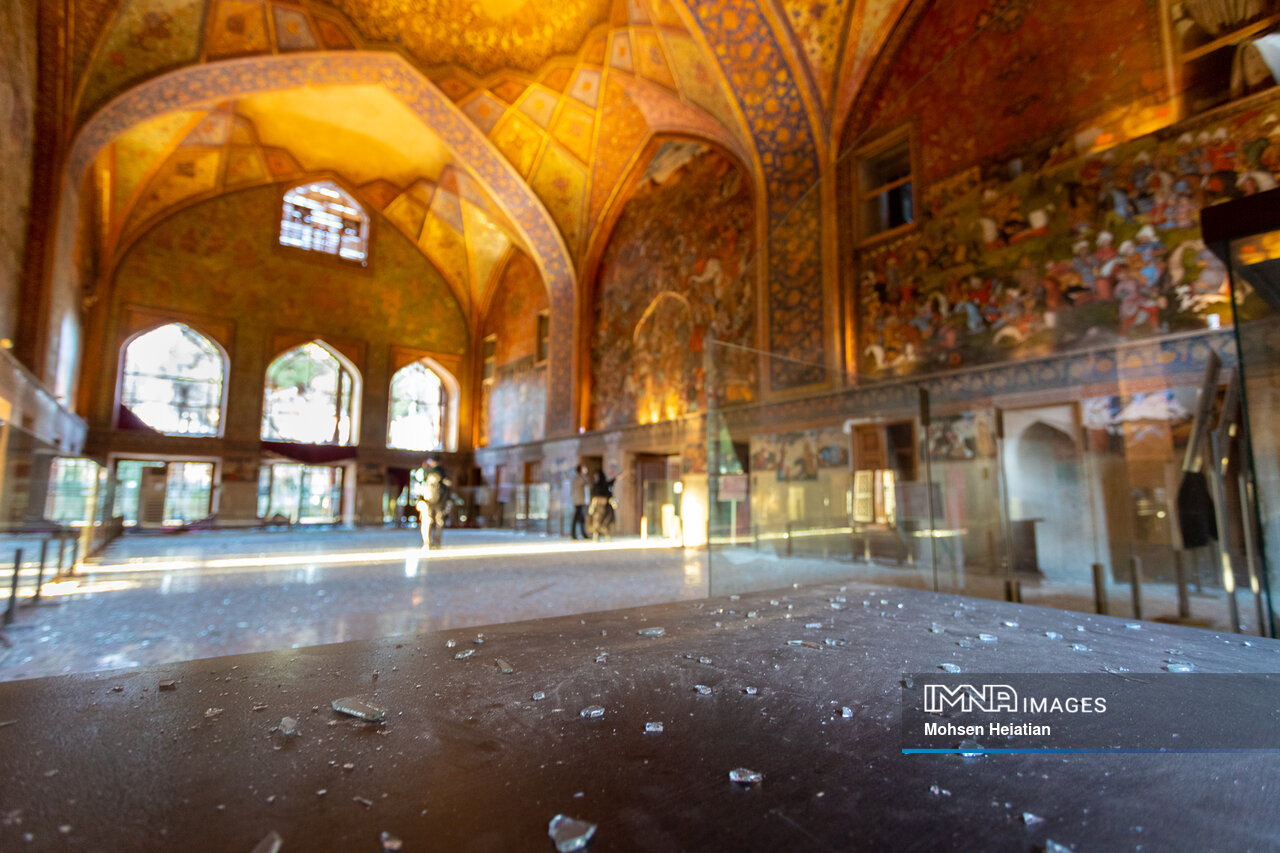
The reported inclination of two or four central columns near the porch’s reflecting pool has been linked to shock waves from explosions during attacks on the Isfahan Governorate building within the historic Safavid Government Complex during the 40-day war.
However, heritage specialists have expressed differing views about the extent to which the explosions caused the structural changes.
Some experts have questioned this explanation, arguing that reinforcement work carried out on the porch columns in the 1970s may already have reduced their vulnerability. They have pointed to the activities of the Italian Institute for the Middle and Far East, known as IsMEO, which worked in Iran on archaeological research, historic-site surveys and monument restoration during the 1960s and 1970s.
Accounts from veteran Isfahan craftsmen, however, suggest that prominent local restorers, including Master Ali Maarefi and Master Ali Manshaei, were responsible for reinforcing the columns rather than IsMEO. According to these accounts, two of the porch columns were not reinforced with steel, and those same columns are now believed to have experienced increased deviation following the bombing of the Safavid complex.
The precise causes and extent of the structural damage remain matters for further technical investigation.
Historic monuments affected by attacks on Isfahan
The damage to Chehel Sotoun forms part of a broader impact on Isfahan’s historic heritage.
According to IRNA, monuments within the UNESCO-listed Naqsh-e Jahan Square complex were affected by attacks on March 8. Further bombing of the Isfahan Governorate building on March 9 caused extensive damage to historic monuments within the Safavid Government Complex, a nationally registered section of the city’s historic-cultural axis.
The affected area includes the second-degree buffer zone of Naqsh-e Jahan Square and the first-degree buffer zone of Chehel Sotoun Palace.
Among the notable monuments reported to have sustained damage were Chehel Sotoun Palace Museum, the Hall of Nobles, the Timurid Hall, the Jebeh Khaneh mansion, which houses Isfahan’s Museum of Decorative Arts, and the Rokn al-Molk mansion, home to the Museum of Contemporary Art. Ali Qapu Palace was also among the historic structures affected by the attacks and resulting shock waves.
The damage has raised further concerns about the protection of Isfahan’s historic urban landscape, where monuments, gardens and architectural ensembles form an interconnected cultural heritage.

A landmark of Safavid architecture
Chehel Sotoun Palace and Garden is one of the most prominent components of Isfahan’s Safavid Government Complex and is inscribed on UNESCO’s World Heritage List.
The garden was established during the Safavid period in the 11th century of the Islamic lunar calendar. One of the palace’s most distinctive features is its central pavilion, whose halls are adorned with remarkable paintings associated with Reza Abbasi, a leading Safavid-era artist renowned for his Persian miniature style.
The palace’s architectural and artistic significance makes its preservation important not only for Isfahan but also for Iran’s cultural heritage and the international community.
With structural assessments and restoration designs still underway, the future of the extensive repair program will depend on the approval of technical plans and the provision of sufficient funding to protect the monument from further deterioration.
Your Comment