

Born around 1315, Hafez is best known for his Divan, a collection of poems dominated by ghazals, a traditional Persian poetic form associated with lyrical expression. His work explores love, longing, beauty, faith, mortality and the contradictions of human life, often combining spiritual symbolism with reflections on society and religious hypocrisy.
His distinctive use of metaphor, ambiguity and layered meanings has allowed generations of readers to interpret his poetry through different personal, philosophical and spiritual perspectives. Although his work emerged from the cultural and intellectual world of medieval Persia, its themes have continued to find audiences well beyond its original historical setting.
A literary tradition rooted in everyday life
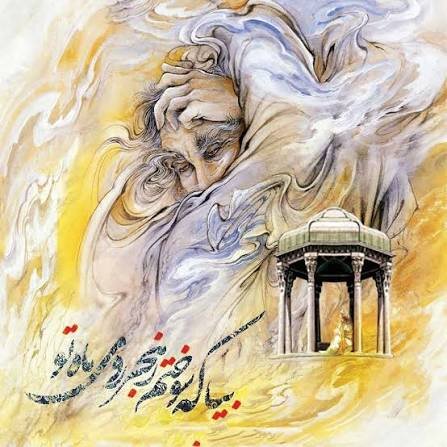
Hafez occupies an unusual place in Iranian cultural life: his poetry belongs both to the literary canon and to everyday experience. His verses are memorized, quoted in conversation, incorporated into music and calligraphy, and passed between generations as part of a shared cultural heritage.
One of the best-known traditions associated with the poet is Fal-e Hafez, the practice of opening his Divan at random and reflecting on the poem that appears. The custom is particularly familiar during family gatherings and celebrations, including Nowruz, the Persian New Year, and Yalda Night, the winter solstice celebration.
Rather than serving only as a literary exercise, the tradition reflects the personal relationship many Iranians maintain with Hafez’s work, turning poetry into a means of reflection, conversation and shared experience.
Shiraz at the heart of the celebrations
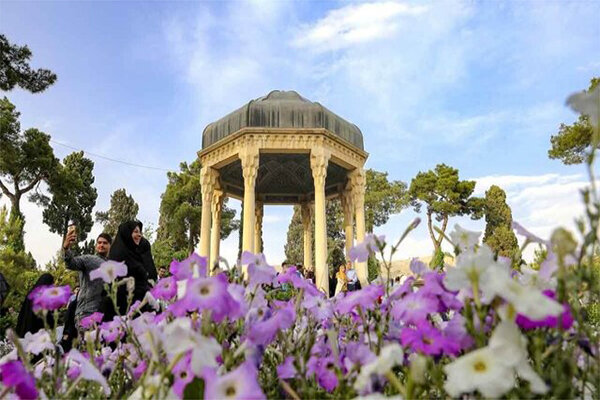
The city of Shiraz, in southern Iran, is the focal point of Hafez Day observances. Visitors gather at Hafezieh, the poet’s tomb and memorial garden, to pay tribute to his legacy. Poetry readings, literary gatherings and cultural programs are among the activities traditionally associated with the occasion.
Hafezieh is more than a commemorative monument. Its open pavilion, landscaped gardens, water features and architectural details create a setting closely associated with the poetic imagination of Shiraz. The site has become one of the city’s most recognizable cultural landmarks, connecting its literary heritage with contemporary public life.
The memorial has developed over several centuries. A structure was erected over Hafez’s grave in the 15th century, decades after his death, and the site underwent subsequent transformations. The present memorial complex took shape in the 1930s, reflecting a modern effort to preserve and reinterpret the poet’s legacy.
Hafez’s relationship with Shiraz also extends beyond the place of his burial. The city’s gardens, landscapes and cultural atmosphere feature prominently in his poetry, making his literary legacy an integral part of Shiraz’s identity.
A Persian literary legacy with international reach
Hafez’s influence extends beyond Iran and the Persian-speaking world. His poetry has been translated into numerous languages and has attracted the attention of writers, scholars and readers across different literary traditions.
The German writer Johann Wolfgang von Goethe drew inspiration from Persian poetry, including Hafez, in developing his West-Eastern Divan, a work that reflects a sustained engagement with Persian literary culture.
Yet Hafez’s international significance does not rest solely on his influence on other writers. His poems continue to invite new translations and interpretations because their central themes—love, freedom, uncertainty, beauty and the complexities of belief—remain open to discussion across cultures and generations.
Hafez Day therefore offers an opportunity not only to remember a major figure in Persian literature but also to consider how poetry can preserve cultural memory, shape a city’s identity and connect people across linguistic and geographical boundaries.
More than six centuries after his death, Hafez remains a familiar voice in Iranian homes and public life. His annual commemoration illustrates the continuing role of literature in connecting historical heritage with contemporary society, while reaffirming Shiraz’s longstanding association with poetry and culture.
Your Comment