

Iran (IMNA) - Speaking on Thursday at the inauguration of a wound treatment center at Al-Zahra (SA) Hospital, Eslami said he was grateful for the opportunity to attend the ceremony, describing scientific advancement as an attainable path, particularly for younger generations.
He noted that anyone seeking to understand how advanced sciences and technologies are achieved need only review university curricula—especially at the master’s level and beyond—to see clearly how the roadmap for scientific progress has been defined.
Referring to years of external pressure, Eslami said prolonged sanctions, psychological warfare and the misuse of various instruments had been employed to block Iran’s path of development. According to him, opponents of Iran made extensive efforts to halt the country’s nuclear industry, which he described as a pioneering sector, and sought to replicate the same restrictive model across other advanced fields of science and technology.
He added that similar approaches were taken in the field of information technology, where industries capable of driving national progress were declared off-limits. Eslami said adversaries had concluded that a country such as Iran—endowed with a unique geopolitical position, valuable resources and a talented human capital base—should not be allowed access to advanced technologies. He emphasized that they understand such a country, under strong leadership, would be capable of challenging systems of domination.
Highlighting the focus of external pressure, Eslami said power-generating advances and superiority-conferring sciences have consistently been targeted, which is why the heaviest pressures have been applied in sectors such as aerospace and nuclear technology.
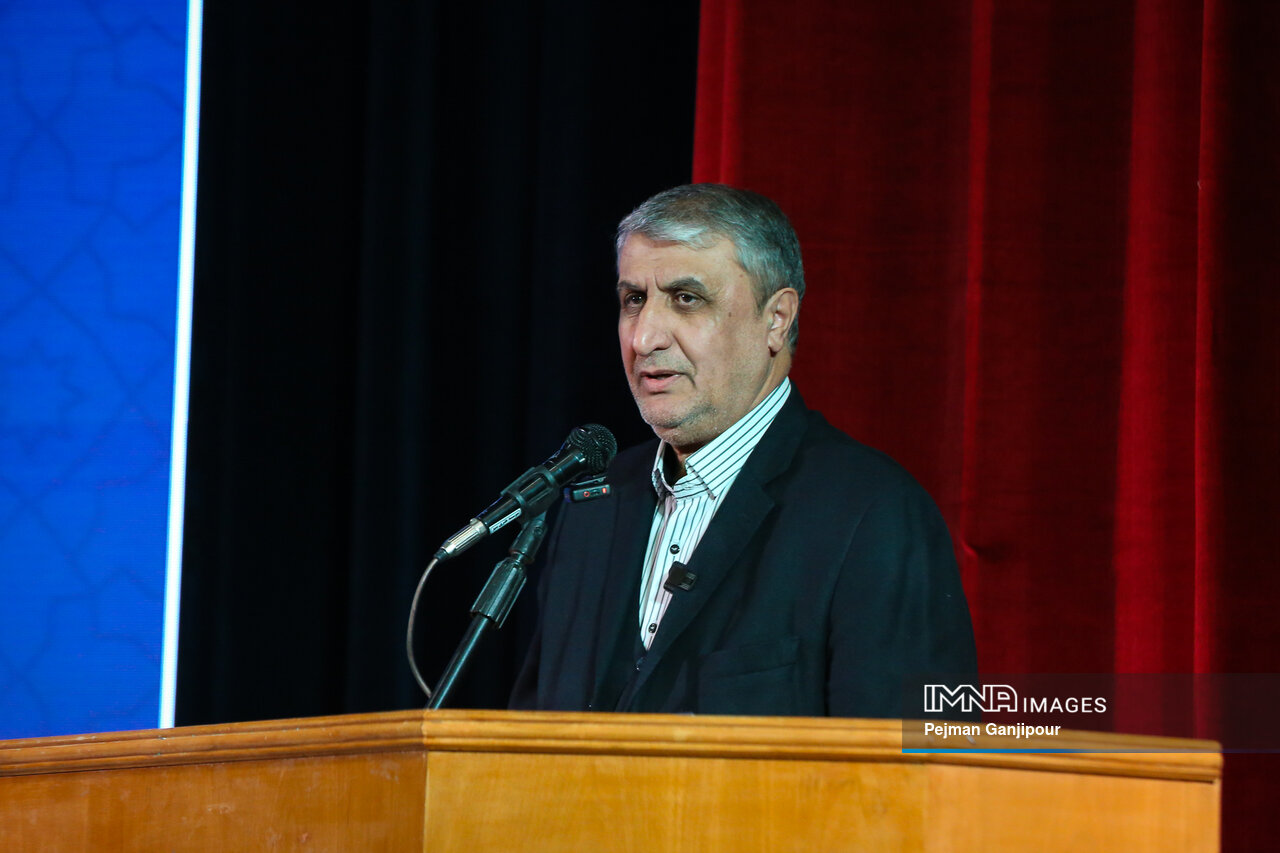
Despite these challenges, he underlined that Iran’s scientific momentum has not been halted. “By the grace of God, Iran’s nuclear industry remains advanced and pioneering, continuing its movement at the frontiers of knowledge,” he said, adding that trust in God and a continuous quest for greater knowledge have remained central principles guiding specialists and experts in the nuclear sector.
Eslami also pointed to the active role of creative young people in transforming knowledge into practical technology. He said the field has always been open to talented youth, allowing them to channel creativity into a process that turns ideas into products. Wherever this cycle is completed, he noted, knowledge becomes technology and products are managed in a way that directly benefits people’s daily lives and the national economy. He described this blend of faith, knowledge and creativity as one of the achievements of the Islamic Revolution, realized through the guidance of the Leader of the Islamic Revolution and the efforts of dedicated professionals.
Turning to public health challenges, Eslami said the healthcare sector is facing a sharp rise in certain diseases due to factors such as climate change, lifestyle shifts and the declining effectiveness of many traditional treatment methods. Addressing these challenges, he said, requires the adoption of innovative approaches.
He stressed the need for convergence and synergy, noting that the Atomic Energy Organization of Iran has placed its highest-level capabilities across various disciplines at the service of the health and medical sectors. According to Eslami, the foundation of nuclear medicine and its related technologies lies in uranium enrichment, explaining that without enrichment and fuel production, radiopharmaceuticals cannot be produced.
At the same time, he noted, Iran’s adversaries openly claim that the country has no right to enrichment and even threaten to destroy enrichment facilities if they are revived.
Referring to publicly available U.S. documents, Eslami said the United States’ National Security Strategy identifies three key technologies for its future progress: artificial intelligence, nuclear technology and quantum technology. The document, he added, also emphasizes a significant expansion of nuclear power plants in the U.S. “The question is,” he said, “if these technologies are considered the right choice for America’s progress, why should they be deemed the wrong choice for the Iranian nation?”
Eslami further pointed out that another part of the document states that previous U.S. administrations erred by pursuing their interests through international organizations and that future policies would rely on military force. He warned that such an approach signals the collapse of the United Nations Charter, adding that attacks on registered nuclear facilities are illegal and inhumane acts that should be condemned, yet have gone uncondemned due to fear of the United States.
Emphasizing the necessity of national power, Eslami said countries lacking power are gradually weakened. He referred to recent global fluctuations in gold markets that affected national currencies, noting that when public اعتراضs emerge, adversaries attempt to exploit them through provocation and structural manipulation aimed at weakening states.
“Today, possessing power-generating, superiority-creating and authority-building technologies is among the essential requirements of governance and one of the country’s most vital needs,” he said, calling for steadfastness in pursuing this path.
Commenting on the opening of the new wound treatment center at Al-Zahra (SA) Hospital, Eslami said the facility—established through the efforts of experts and the support of officials—is one of the country’s most important centers in the field of plasma therapy. He emphasized that the significance of the center lies in the introduction of this technology into Isfahan’s healthcare system, as well as its potential for education and research.
He said that wherever medical universities have entered this field, societies familiar with the technology have been impressed by its impact. Describing Al-Zahra (SA) Hospital as one of the country’s distinguished medical institutions, he said it is capable of playing a leading role at the national level.
Addressing the rise in cancer cases, Eslami said cancer rates in Iran are increasing exponentially and that many previous solutions are no longer sufficient. He stressed that effective and modern solutions can only be achieved through convergence and synergy.
Highlighting achievements in radiopharmaceutical production, Eslami said Iran currently produces 72 types of radiopharmaceuticals, some for therapeutic use and others for diagnostic purposes. He described these products as up-to-date and a source of national pride, adding that 20 additional radiopharmaceuticals are in the research and development stage.
He concluded by saying the path ahead is manageable, with a wide range of impacts already targeted and being pursued seriously. These achievements, he said, are dedicated to the great nation of Iran. Eslami also announced the signing of a memorandum of understanding aimed at expanding related technology centers nationwide, noting that Isfahan has been selected as one of the main hubs. Two centers have been prioritized for immediate development, one of them in Isfahan, which he said is expected to become operational within the next three years as academic and professional efforts in the field continue to grow.
Your Comment