
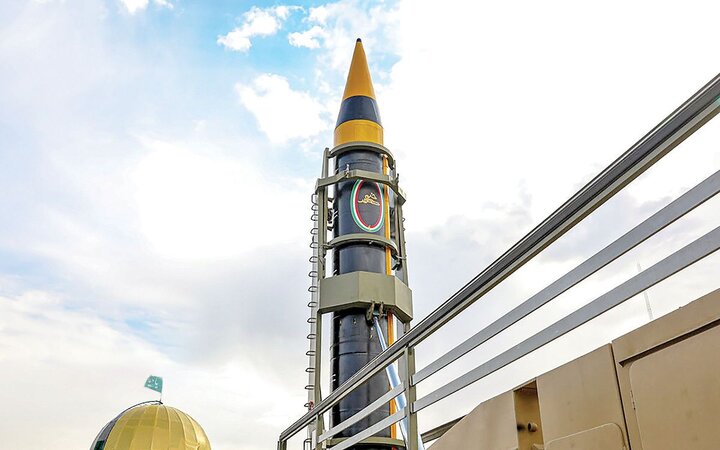
Iran (IMNA) - According to unofficial sources, the missile boasts a range of up to 12,000 kilometers, a speed of Mach 16 (about 20,000 km/h), and can carry a 2-ton warhead. This range is significantly greater than Iran’s current longest-range ballistic missiles, such as the Khorramshahr 1-4 series, which have an estimated range of up to 4,000 kilometers.
The missile’s reported speed of Mach 16 aligns with typical ICBM speeds during mid- to terminal flight phases. Iran’s hypersonic missile tests, such as those involving the Fattah missile reaching Mach 15, demonstrate relevant technological competence. The Khorramshahr-5’s notable warhead weight of approximately two tons reportedly matches the destructive power of American bunker-buster bombs. However, the relationship between warhead payload and range is complex; heavier payloads generally reduce range. Iranian Defense Minister Brigadier General Aziz Nasirzadeh confirmed testing of a two-ton hypersonic warhead in June but did not explicitly link it to an ICBM system, indicating its potential use with medium- and intermediate-range ballistic missiles like the Emad and Khorramshahr.
Additional reported physical characteristics—such as a length of 12 meters and mass of 14-15 tons—are considered unreliable or inconsistent with claims of liquid fuel propulsion and the heavy warhead. While some speculate about the use of converted civilian carrier rockets like Simorgh or Soroush models to achieve intercontinental range, such adaptations are unlikely due to their slow fueling times and vulnerability.
The Khorramshahr-5 missile is portrayed as a potentially transformative advancement for Iran’s missile capabilities, featuring extended range, high speed, and a powerful warhead, though much information remains unofficial and unconfirmed. The missile’s emergence raises significant geopolitical and security implications, notably regarding Iran’s missile doctrine and regional power dynamics.
Your Comment