

Iran (IMNA) - Muharram, the first month of the Islamic calendar, holds special significance for Shi'a Muslims due to the tragedy of Karbala and the martyrdom of Imam Hussein (AS), the grandson of Prophet Muhammad (PBUH), along with 72 of his companions on Ashura (the 10th of Muharram, 61 AH). After the martyrdom of the third Shi’a Imam, Muharram became a month of mourning for Shi'a Muslims worldwide, with Ashura holding particular importance.
Across the globe, large-scale mourning ceremonies and rituals during Muharram convey the enduring message: “Every day is Ashura and every land is Karbala.” In Iran, people in every city observe these ceremonies with unique local customs in various religious venues to honor the sacrifice of Imam Hussein (AS).
Zanjan province, known as the capital of passion and recognition for Imam Hussein (AS), draws hundreds of thousands of mourners from Iran and abroad each year to the Grand Husseiniya of Zanjan. This religious site, with a history spanning over a century, was endowed by Haj Mirza Mohammad Naghi and Haj Mirza Babaei.
On the Day of al-Abbas, nearly 500,000 mourners participate in a renowned procession, walking more than 2 kilometers from the Grand Husseiniya to Imamzadeh Seyyed Ibrahim. Dressed in black, participants express their grief by beating their chests, accompanied by drums and the recitation of elegiac poems by a Maddah (eulogist) recounting the events of Karbala and the bravery of Imam Hussein (AS). The scale and grandeur of this procession are unmatched elsewhere in Iran.
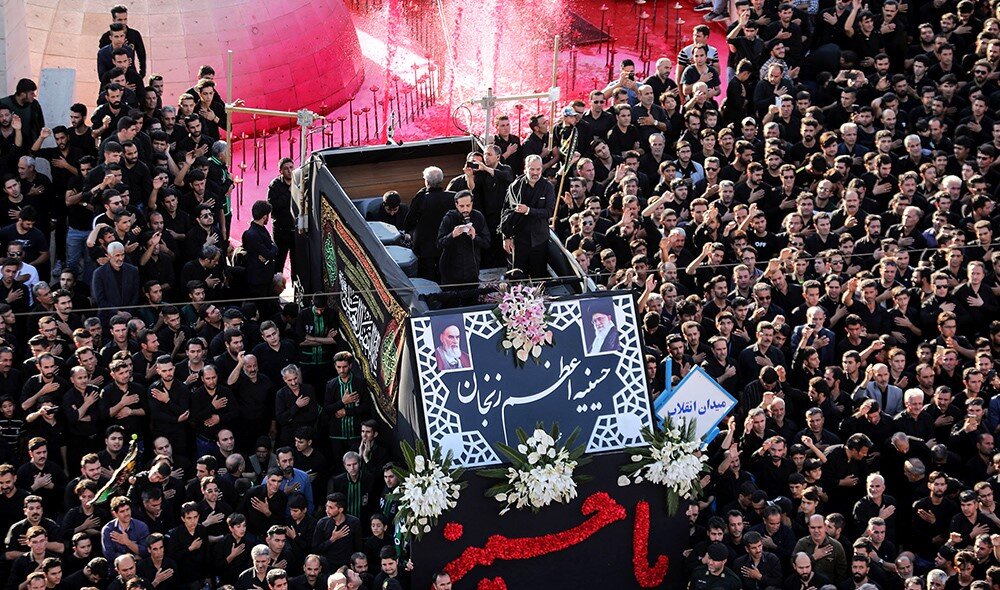
This extraordinary event is broadcast live annually on IRIB TV, international channels, and online platforms, allowing viewers worldwide to witness it. In recognition of its unique cultural and spiritual significance, the procession of the Grand Husseiniya of Zanjan was registered as Iran’s tenth cultural and spiritual heritage on January 4, 2009.
In terms of sacrificial offerings during Muharram, the Grand Husseiniya of Zanjan is considered the first altar in the Shia world and the second in the Islamic world after Mina in Mecca. Thousands of sacrificial animals, including camels, cows, and sheep, are donated each year by mourners, with a record of 12,000 animals sacrificed in recent years. The meat is distributed to the needy in the province, supporting their livelihoods.
Additionally, mourners and religious visitors contribute significant amounts of money and gold annually, which are used for charitable projects such as building schools, clinics, libraries, and creating jobs. In Muharram 2021, donations totaled 4.5 billion tomans, highlighting the Husseiniya’s role as a major Shi'a center.
Each year, on the first Friday of Muharram, the Husseiniya of Zanjan also hosts the ‘Hosseini infants’ ceremony, where mothers gather to commemorate Ali Asghar (AS), the six-month-old son of Imam Hussein (AS) and the youngest martyr of Karbala.
Your Comment