
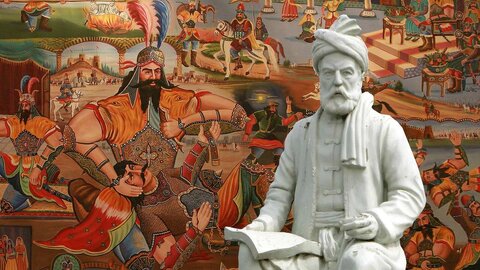
Iran (IMNA) - Against the backdrop of a world where Arabic threatened to eclipse Persian, he undertook a monumental task: to gather the scattered pearls of Iran’s myths, legends, and histories and string them into a single, unbroken necklace-the Shahnameh.
The Book of Kings, wrought from over three decades of labor, stands as the longest epic poem ever composed by a single hand, a tapestry woven with 50,000 couplets that chronicle Iran’s journey from the dawn of creation to the fall of its last native dynasty. In its verses, the world is born anew: mountains rise, demons are vanquished, and kings rule with justice-or fall to their own hubris. Ferdowsi’s pen conjures the splendor of ancient courts, the clash of heroes, and the sorrow of loss, each scene rendered in Persian so pure and melodious that it would become the very standard for generations to come.
The Shahnameh is not merely a chronicle of kings and battles. It is a mirror held up to the soul of a nation, reflecting its virtues-courage, loyalty, justice-and its vices-betrayal, pride, and the tragic cost of fate. Through the tales of Rostam, Sohrab, Zal, and countless others, Ferdowsi explores the eternal struggles of humanity, binding Iranians to a shared past and a common destiny. His work became a bulwark against oblivion, a declaration that Persian identity would not be erased but instead would flourish, resilient and proud.
Ferdowsi’s genius lies not only in his storytelling but in his language. At a time when the courts and scholars turned increasingly to Arabic, he chose to write in Persian, shunning foreign words and reviving the music of his ancestors’ speech. In doing so, he rescued a language from the brink, ensuring its survival as the vessel of culture, art, and thought. The Shahnameh became the cornerstone of Persian literature, its rhythms and imagery shaping poetry, art, and philosophy for centuries.
His final years were marked by hardship and neglect, yet his legacy outshone the darkness of his days. Ferdowsi died around 1020 CE, denied a place in the local cemetery, but his tomb in Tus became a shrine for all who cherish Persian heritage. Today, as Iranians gather to celebrate Persian Language Day, they honor not just a poet, but a guardian of memory, a beacon whose light has guided their language and identity through the storms of history.
Ferdowsi’s Shahnameh endures-a living testament to the power of words, the resilience of a people, and the enduring beauty of Persian culture. From the halls of kings to the hearts of ordinary Iranians, his verses continue to inspire, to teach, and to unite. In every line, the spirit of Iran breathes, undiminished by time, as vibrant as the day Ferdowsi first set pen to paper.
Your Comment