
A brief history of pigeon houses
No clear record is available on when or where in the world pigeon houses were first erected as a fertilizer manufacturing unit. However, evidence shows that they already existed in the 4th century Hijrah (about 10th century AD) and that many were under construction. It is believed that pigeon houses might have been constructed even long before that time and our records indicate that they might date back to any time between 1200 to 1100 years ago.

The Architecture
Pigeon houses are not only magnificent landmarks of architecture with respect to their vast geographical distribution but are also fascinating for their diversity in form and design. Like other Iranian architectural designs, pigeon houses serve multiple purposes ensemble and take a vast variety of forms and shapes. They represent a deep understanding of the local climate and environment on the part of the architect who created such amazing and eternal structures to serve man.
Firstly, these houses act as strong impenetrable fortifications that ward off the too many enemies of pigeons and the aggressively dangerous predators like eagles, owls, and crows; in this way, they provide a safe haven for the pigeons to safely commute and reside. They were constructed so meticulously and with such precision that no other bird could find its way into them.
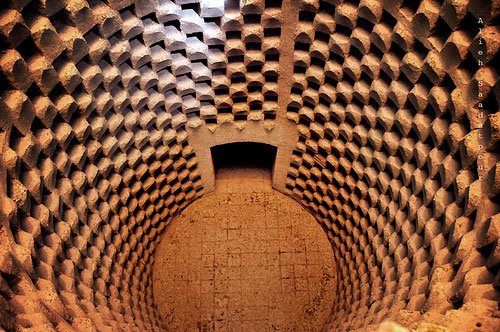
The interior is so pleasant to pigeons that as many as 25,000 of them have at times been seen together in one pigeon house. These dens of regular and uniform geometries are beautifully constructed of clay materials to provide cool spaces in the sweltering hot days of the desert with a cool breeze blowing in through their structurally designed wind collectors; in cold piercing winters also, these same structures block out the chilly desert winds.
These architectural provisions are supplemented with inlet holes in their walls with as uniformly small diameters as only pigeons would be able to pass through. In some designs such as those common in Khomein or Golpayegan, the identical hole diameters in the pigeon houses are maintained by using clay pipes of uniform size installed in the walls during construction. This provision would only allow pigeons to pass through.
Another important provision in the architectural design was the horizontal and vertical expanse of the building that had was stair-like and multi-floored to allow for easy repair and maintenance. In arid areas where no flowing water body was available, well were dug to supply water for the birds. A fantastic idea developed by Iranians to both keep beasts and preying animals away and to attract pigeons into these structures was the use of odors derived from certain animals like wolves and hyenas or those from plants such as rue as well as such incense as Indian olibanum.
Pigeon houses have won wide recognition for their beautiful architecture and the economic role they played in the farmer’s life by producing and supplying the best fertilizer for their farms.
Investigation of these structures reveals the deep knowledge of acoustics their architects employed in the design as it would happen at times that as many as 14,000 to 25,000 pigeons swarmed simultaneously into these dens. The swarm and the simultaneous flight of this number of birds together would create strong vibrations with an accompanying resonance and a great energy at no damage since the structure was designed and built in a manner to damp out the noise and the energy. The design also reveals the sound and practical knowledge of such varied fields as zoology, animal psychology, chemistry, climatology, botany, mechanics and biology underlying their architecture.
The geometry of pigeon houses
Pigeon houses come in a variety of geometrical shapes. The most dominant geometry used in building pigeon houses is the circular one. These are mostly found in Isfahan and the neighboring areas. Another geometry is the cubic one characterized by four distinct corners; these pigeon houses are mostly found in northwest of Isfahan in Golpayegan and Khansar. There is also a third type of combined geometry or multiple pigeon houses commonly erected in Lenjan, west of Isfahan.
The circular geometry gives rise to a cylindrical pigeon house. These typically consist of an external shaft which is built with a thinning tip (i.e., its topmost section is narrower than its base) for better structural stability and is connected to the core inner shaft by connection elements. The main (outer) shaft is divided up into several floors along its vertical axis, each forming a hallway while the floors are connected through a flight of steps that wind around the core shaft to end up on the roof of the tower. The hallways, or corridors, are indeed the top parts of curved or dome-like roofs separating each floor. A dome forms the topmost roof of the tower. All the domes have holes of uniform size in them for pigeons to fly freely above and below the domes, or in and out of the whole tower. Small domed shafts (called ‘pepper particles’ with holes in their walls, rather than in their ceiling) are built of hive-like brick walls on top of the tower roof for pigeons and doves to enter the den. The main domed shaft, or pepper particle, is based on the core shaft of the tower while others are deployed on circles around it on the external shaft. The number of these small shafts depends on the tower design.
Cubic pigeon houses are rectangular in geometry and are in cases built in the form of twin towers. Being generally simpler in design than the cylindrical ones, they mostly represent a large spacious room with small dens built in their walls. This type of design is mostly found in Golpayegan, Khansar, and Khomein in Isfahan Province. Unlike other types of pigeon houses, the cubic ones lack any landing apron in front of the pigeon dens. Rather, landing aprons are made with wooden frames that connect two longitudinal walls of the den. Cubic pigeon houses have two gates, one at the top part of the tower body and one under the top gate which is used for inspections, snow removal, fertilizer collection, or feeding pigeons in cold winter times. The lower gates which are typically used for collecting and removing fertilizer piles are sealed with such materials as clay, plaster, bricks, or stones.

Multiple pigeon houses, mostly seen in the villages of Akhgar, Sohru, and Firoozan located in Lenjan Region, consist of several shafts (or hives) in which a smaller shaft is built on top of several underlying shafts. The independent hives in these pigeon houses are connected to each other by walls along the length and width of the tower to form a unified whole. Each shaft maintains the same cross section along its height but only slightly widening at the tope where the dome-like ceiling starts. The hives in these pigeon houses are sown together, so to speak, with wooden frames (or, wooden bands) at the mid and top part of the tower along both the longitudinal and traverse directions. Within each hive are located the pigeon dens adjacent to each other. Multiple pigeon houses typically have a single entrance which, as in other types, is commonly closed and sealed with stone, clay bricks, and muddy mortar paste. Each hive of dens also has an entrance which always remains open. A tower with a perforated pattern mounts on top of each hive and its top small shafts. Birds can fly in and out through the holes in these small top turrets. Multiple pigeon houses are not only spacious and plain in structure but also simple in design with no special decorative work such as brick or gypsum bands or perforated battlements. It may be said that the only decorative design in these dens include a plaster strip around the mid height of the tower and the stepwise increasing section at the top part of the hives.
Construction materials used
The main construction materials used included unbaked clay bricks, muddy mortar, and straw-muddy mortar. Bricks are used for making perforated turrets, roofing, and the pavement on the roofs. Plaster is used for linings and strips. Foundations are constructed out of rock pieces and lime. Wood is also sporadically used as a main material in pigeon houses to make banding frames or landing aprons in pigeon houses lacking a constructed apron in front of the dens. Baked clay pipes are used to form entrance holes into the dens.
Safety of the pigeon houses
Pigeon houses are extraordinarily magnificent in their interior design owing to their form diversity and the multitude of functions they serve, which is a general characteristic of Iranian architecture. The design of circular sites with interconnected labyrinth-like spaces has given the structure its superb strength and stability. Moreover, the circular surfaces and cylindrical spaces keep the hunting snakes away as they are not able to climb such curves surfaces. A French travelor once wrote of the colossal size of the pigeon houses being six times larger than the largest structures in France used for raising poultry. He then went on to give a detailed description of the pigeon houses as went above in this article.
Applications of pigeon houses
Farmers used to mix pigeon foul with ash and used it to fertilize soil. Additionally, the foul had found applications in processing leather or manufacturing explosives. These were the reasons for the heavy taxes levied by the Safavid government on pigeon houses. Depending on their size, pigeon houses would accommodate between 1,000 to some 40,000 pigeons at a time. They would thus create a great source of income for their owners due to the huge amount of fertilizer they would be able to collect. Estimates indicate that as much as 70,000 kg of fertilizers would be collected annually from one pigeon house that accommodated 7,000 pigeon couples. This would make great revenues for the farmers.
Pigeon houses and international tourists
The Moroccan Ibn-i-Batūtih was the first traveler who wrote about pigeon houses in Iran. During his long visit to Iran around 5 centuries ago, he visited the pigeon houses between Filan and Isfahan and wrote: “Filan is a large village built on the banks of a huge river with a beautiful mosque in it. During that day in July, we continued our way through orchards, streams, and picturesque villages and saw so many pigeon houses before we reached Isfahan on the following day.” About 2 centuries later, the French Jean Chardin, the French jeweler and traveller, dedicated one volume (entitled Travels in Persia, 1673-1677) of his ten-volume book The Travels of Sir John Chardin exclusively to the then-Iranian capital city, Isfahan. He wrote: “I am convinced that Iran is the place where the best pigeon houses are erected, all of which are built for collecting fertilizers rather than for feeding and raising birds.” He then adds: “This fertilizer is called Chalghuz in Persian meaning stimulator and nutrient; the fruits in Isfahan and the whole Iran indeed owe their live colors, flavor, and taste to these pigeon houses. Thomas Herbert, the English traveller and historian, also wrote: “Although Iranian homes were clean and beautiful but were in no way comparable to those of their pigeons with their queer looking façade.” Eugène Napoléon Flandin, the French orientalist, wrote: “In the area between Jolfa and the deserted lands, we came across pigeon houses that catch one’s eyes for their colossal, strong, and beautiful appearance.”
.jpg)
Why pigeon houses went to ruin?
After 400 years, the number of pigeon houses has now declined from the original 3000 to only about 300 at present. Until last year, only 65 of the remaining ones were inscribed on the list of national tourist and cultural works of Iran. Changes in human life style over the past one-hundred years have led to a gradual decline in the role and significance of pigeon houses. Their ownership, which used to be a family inheritance in the past, belonged to the landlord or ruler of the region. They have lost their meaning and significance to the daily Iranian life due to the recent changes in farming practices. Pigeon houses were once traded as property; however, when the inexpensive agrochemicals were made easily available and introduced for use as fertilizers, no room was left for the hard work of collecting bird foul and the trouble to prepare fertilizers out of it. This was accompanied by the sprawling urbanization which devoured pigeon houses into residential areas and frightened the birds away; they no longer showed the willingness to dwell in pigeon houses once built for them and to make their small nests inside them. The birds in most cases fell victim to the hands of hunters. Late in the Qajar period, unchecked hunt of pigeons was one of the hubbies of the Ruler of Isfahan; this led to the sharp decline in the number of the species in the region. Finally, no efforts were made to repair and maintain the towers, while irrigation water has through time found its way on farms to the foundations of these towers, and snowfalls and rainfalls on their roofs lacking proper sloping and drains have also led to the devastation of most pigeon houses.
Some of the pigeon houses in Isfahan
Below is a brief list of pigeon houses remaining in Isfahan:
Imam Khomeini Pigeon House: Having a height of 11.25 meters and a diameter of 6.7 meters, it is located on Imam Khomeini Road with a façade of plaster and straw-muddy mortar. Its interior is made of bricks and straw-muddy mortar.
Gavart Pigeon House: This tower is located in Gavart Village of Ghahab Region in central Isfahan Province with the highest density of pigeon houses. The tower has an internal, or core, shaft as well as an external one. The external one is slightly inclined toward the center to ensure stability. It has 9 turrets on the roof with perforated brickwork which provide entrance for the birds, ventilation, and illumination. The tower is … m high and its external shaft is 6.6 m across.
Raddan Pigeon House: This cylindrical tower is located along the banks of a water channel in Raddan village at a distance of 3 km southeast of Isfahan. The tower is 13.30 meters across and its largest shaft is 10.20 m in height.
Mardavij historical pigeon house: This tower dates back to the 16th century. It is not completely circular in shape but resembles a flower with 8 circles around the tower standing for its corolla and one in the center. The tower is 18 meters high and its base diameter is 16 meters. Although simple building materials of unbaked clay bricks, muddy mortar, and earth have been used in its construction, it is an engineering and architectural masterpiece. The tower is built in three stories with 15,000 pigeon nests inside that would house 15,000 pigeons. There are also 770 holes on the tower top which provide entrance for the pigeons into 12 shafts and the central one. These holes are 18´20´25 cm in dimensions exactly the size of pigeons, thus allowing no other bird species in.
Hezar Jerib Tower (on Sheikh Sadough St.): The tower consists of 8 small shafts surrounding a large core one in the center which is 13.20 m high and 13.5 m across. The elements connecting the external shafts to the internal one strengthen the whole structure as a whole so that the simultaneous flight of several thousand birds would not cause any damage to the tower.
The highly profitable and vital functions of these valuable structures in farming have remained undisclosed to our modern society. Producing the highest quality world class fertilizers, these magnificent structures nowadays beg for our undivided attention in collaboration with the ICHT to safeguard them as our cultural legacy and one of our tourist attractions./ER//
Your Comment