
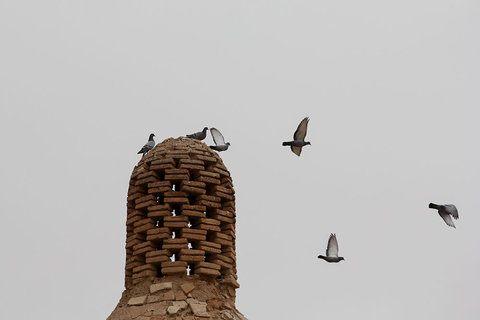
Iran (IMNA) – Dating back in many cases to the Safavid era, these distinctive structures represent an important example of traditional Iranian architecture and agricultural ingenuity. Built primarily from locally sourced mud bricks and earth, the towers were designed not only to accommodate large numbers of pigeons but also to support an agricultural system based on collecting bird droppings and using them as natural fertilizer.
Alireza Izadi, director-general of the Office for Registration, Preservation and Rehabilitation of Cultural Heritage at Iran’s Ministry of Cultural Heritage and Tourism, raised the prospect of their international recognition during a meeting of the Supreme Council for the Registration and Buffer Zones of Immovable Heritage in Falavarjan, Isfahan Province, Mehr News Agency reported on Saturday.
Izadi described the structures as valuable cultural assets and emphasized the need to prepare a comprehensive nomination dossier to introduce their significance internationally. He also highlighted the importance of documenting the climatic, historical and cultural characteristics of heritage properties, completing registration records and securing cooperation between government institutions, municipalities and the private sector to support their preservation.
Architecture developed through environmental adaptation
The architectural characteristics of Isfahan’s pigeon towers reflect generations of practical knowledge shaped by the region’s climate, available construction materials and agricultural requirements.
Architect Arman Farahmand explained that these buildings should primarily be understood as functional structures responding to particular economic and environmental conditions rather than being assessed solely on their visual appearance or size.
Their internal organization was carefully designed to accommodate pigeons and make the collection of their droppings more efficient. Numerous nesting niches were incorporated into the walls, while openings provided appropriate lighting and ventilation.
Local mud bricks and earth were widely used because of their availability, affordability and thermal performance in the hot, dry climate of central Iran. Traditional construction methods also incorporated arches to reinforce walls and barrel-vaulted ceilings to support the buildings.
Many towers reach approximately 10.5 to 12 meters in height. Despite differences in their architectural forms, several share comparable structural principles, particularly in the arrangement of interior spaces and the distribution of structural weight.
Farahmand stressed that the towers should not be considered a single, uniform architectural type. He called for detailed field surveys, architectural drawings, precise measurements and investigations into traditional construction techniques to establish their common features and regional differences.
Such scientific documentation would provide an essential foundation for any future international heritage nomination.

A traditional agricultural system with economic value
Beyond their architectural characteristics, pigeon towers played an important role in the agricultural economy of central Iran.
Sohrab Nikpey, a researcher specializing in agricultural history and rural economy, said the structures were integral to traditional farming practices, particularly through the collection of pigeon droppings, which were used to enrich agricultural soil.
Historical travel accounts also provide evidence of their economic importance. European travelers, including Jean-Baptiste Tavernier and Thomas Herbert, recorded the presence of pigeon towers around Isfahan. French traveler Jean-Baptiste Chardin also referred to their considerable numbers and the economic value of the fertilizer obtained from them.
These historical observations offer insight into the contribution of pigeon towers to the agricultural economy of the region, particularly during the Safavid period.
Their principal function also distinguished them from many traditional European dovecotes, where pigeons were commonly raised for meat. In Isfahan, the main objective was to collect guano for agricultural purposes. The resulting fertilizer was particularly valuable for melon cultivation, a crop historically associated with the region. Historical accounts also mention its use in gunpowder production.
The towers therefore formed part of a broader production system in which architectural design, animal management and agricultural practices were closely interconnected. Their importance extended beyond individual buildings, reflecting a traditional approach to making productive use of locally available natural resources.
Demonstrating their Outstanding Universal Value
Despite their historical and architectural importance, securing a place on UNESCO’s World Heritage List would require more than establishing the age or distinctive appearance of the structures.
Mahtab Rastegar, an expert in World Heritage policy and comparative studies, explained that a successful nomination must demonstrate Outstanding Universal Value through reliable research and comprehensive documentation.
For Isfahan’s pigeon towers, one of the most important aspects to investigate is the relationship between traditional architecture, agricultural technology and environmental adaptation.

Comparative research would be particularly important in this process. Researchers would need to examine similar structures in Iran, Turkey and other countries to determine what distinguishes the Isfahan examples in terms of architectural organization, building techniques, economic functions and responses to environmental conditions.
The existence of comparable structures elsewhere would not necessarily rule out a UNESCO nomination. However, the proposed dossier would have to establish why the selected towers represent an exceptional example of this architectural and agricultural tradition.
Rastegar also emphasized authenticity, integrity and long-term protection as essential considerations. Any historical alterations or damage to the original structures would need to be properly recorded. Furthermore, the nomination would require clearly identified management authorities, a sustainable conservation strategy and effective measures to prevent inappropriate restoration or development.
Without a reliable protection and management framework, historical and architectural documentation alone would not be sufficient to support a successful nomination.
Environmental damage puts historic structures at risk
The physical condition of the surviving towers presents another major challenge, particularly because their traditional earthen construction makes them vulnerable to moisture and weathering.
Bahram Kavyani, a specialist in the restoration of earthen buildings and traditional architecture, said exposure to rainwater, rising damp, deteriorating protective plaster and inadequate maintenance could gradually undermine the stability of mud-brick structures.
Although unfired mud bricks are well suited to dry climatic conditions, water penetration can accelerate deterioration. Damage frequently develops around rooftops and the points where roofs meet walls, allowing moisture to enter and weaken the building materials.
The considerable height and complex internal arrangements of pigeon towers also make structural assessments particularly demanding.
Kavyani cautioned that restoration projects carried out without sufficient technical knowledge could cause additional damage. He recommended preparing a comprehensive technical inventory of every surviving tower before undertaking conservation work.
The inventory should cover geographical location, architectural drawings, construction materials and methods, foundation conditions, structural cracks, surface erosion, rooftop conditions and any alterations made throughout the buildings' history.
He further stressed that conservation measures should be designed separately for each tower, taking into account its particular structural condition and architectural characteristics.

From regional landmarks to international recognition
Establishing the potential World Heritage value of Isfahan’s pigeon towers will require a coordinated program combining historical research, architectural documentation, comparative studies and practical conservation.
An initial priority would be to identify and register all surviving examples, recording their locations, historical backgrounds, ownership status, architectural authenticity and current physical condition.
A 2011 study published in the academic journal Antiquity, which examined Safavid-era pigeon towers around Isfahan, offers an important starting point for further research. The study documents aspects of their architecture and history while examining their distribution and connections with the region’s traditional agricultural system.
Combining this existing academic research with new field investigations, detailed architectural surveys and international comparisons could provide a stronger scientific basis for determining whether the structures meet UNESCO’s Outstanding Universal Value requirements.
Today, the widespread adoption of industrial fertilizers has largely replaced the agricultural practices that once made pigeon towers economically essential. Many of these historic buildings have consequently lost their original productive function.
Nevertheless, they remain significant reminders of Iran’s architectural heritage, traditional agricultural knowledge and the close relationship between human settlements and their natural environment.
Their possible inclusion on the World Heritage List would depend on demonstrating that significance through credible research while ensuring that the surviving structures receive the protection and conservation they require.
Your Comment