

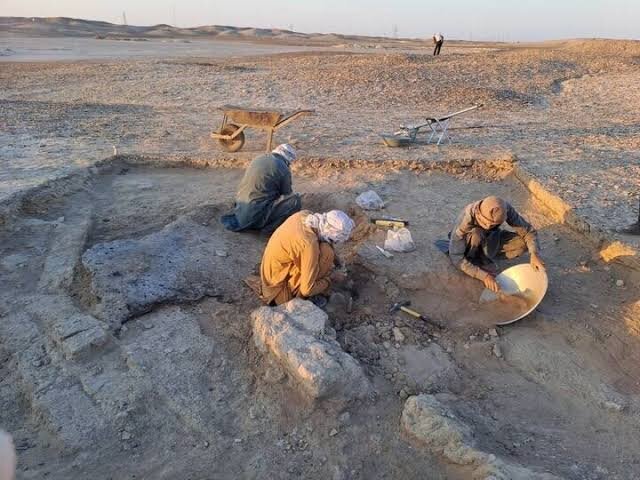
Iran (IMNA) - The discoveries were made during the 21st season of archaeological excavations at the UNESCO-listed Burnt City, or Shahr-e Sukhteh, in southeastern Iran. Archaeologists say the findings provide new information about the social life, culture, crafts, entertainment and daily practices of the people who inhabited the ancient settlement.
Rouhollah Shirazi, head of the excavation team at the Burnt City, said the latest discoveries include a previously unknown type of board game, an engraved bone comb, organic materials such as eggshell, textiles and leather, as well as previously undocumented burial practices.
“These discoveries can provide researchers with new information about less-known aspects of the life, culture and social relations of the inhabitants of the Burnt City,” Shirazi said, according to a report published by Miras Aria on Wednesday.
For cultural tourism, such discoveries are significant because they transform an archaeological site from a collection of ancient structures and artifacts into a more tangible story about the people who lived there. Evidence of games, personal grooming, clothing, food-related materials and craft production can help visitors develop a clearer understanding of how people lived more than four millennia ago.
Located about 56 kilometers south of Zabol in Sistan-Baluchestan province, the Burnt City covers approximately 273 hectares and was inhabited from the late fourth millennium through the third millennium BC. The settlement continued through four major cultural periods and represents one of Iran’s most important archaeological landscapes.
Its scale, age, archaeological richness and evidence of long-distance contacts give the site considerable potential for heritage tourism, particularly for travelers interested in ancient civilizations, archaeology and the history of urban development.
Archaeological discoveries strengthen tourism potential
The latest excavation season began on July 20, 2026, and is being conducted in three areas: one in the residential quarter and two in the cemetery.
In the northeastern section of the residential area, archaeologists identified two architectural phases and uncovered evidence connected with everyday activities and craft production. Animal remains, tools, stone-working debris, plain and decorated animal figurines and hearths were found within architectural spaces.
According to Shirazi, the evidence indicates that the area was not exclusively an industrial quarter. Instead, it appears to have been a multifunctional space where residents carried out everyday activities alongside certain forms of craft production.
Such evidence can add an important experiential dimension to tourism at the Burnt City. Rather than presenting the ancient settlement only through monumental remains, archaeological research increasingly makes it possible to reconstruct ordinary activities and explain how different parts of the city functioned.
The cemetery has also produced a diverse collection of finds, including new burial types, organic remains, plain and decorated pottery and polychrome ceramics.
A 4,600-year-old game offers a glimpse into ancient leisure
Among the most important discoveries is a distinctive board game dating to the third millennium BC.
Shirazi said the discovery could provide a new perspective on social life and entertainment at the ancient settlement.
From a tourism perspective, the game is particularly valuable because it provides an accessible connection between contemporary visitors and people who lived at the site thousands of years ago. Evidence that ancient residents engaged in leisure and entertainment can make archaeological interpretation more relatable and help cultural tourism experiences move beyond traditional displays of pottery, tools and architectural remains.
Together with other discoveries from the cemetery, the game indicates that life at the Burnt City involved more than subsistence, production and basic needs, pointing to a society with diverse and complex social and cultural practices.
Organic remains reveal the everyday life behind the ancient city
Archaeologists have also recovered organic materials, including eggshell, textile fragments and leather.
The preservation of such materials is particularly significant because organic remains generally deteriorate under environmental conditions, natural processes and the passage of time.
Their survival can provide direct evidence of past lifestyles, technologies, economic practices and consumption patterns, Shirazi said.
For visitors, these discoveries offer another opportunity to understand the ancient city through everyday objects and materials. Textiles, leather and food-related remains can help reconstruct aspects of clothing, crafts, diet and household activities, creating a richer narrative for heritage interpretation and museum exhibitions.
Unique decorated bone comb adds to the site’s tourism narrative
Another notable discovery is an engraved bone comb that, according to Shirazi, has no known counterpart so far from the region. Comparable examples have only been reported from some archaeological sites in Central Asia.
The comb and its engraved decoration could contribute to research into artistic practices, manufacturing technology, ornamentation, grooming and the cultural and social relationships of the inhabitants of the Burnt City.
The object also has considerable potential for cultural tourism interpretation because it represents a personal item rather than a purely monumental or industrial artifact. Such objects can provide visitors with an intimate perspective on the people who lived at the ancient settlement.

Burnt City: a gateway to Iran’s Bronze Age heritage
The Burnt City was a major center of the Helmand civilization and one of Iran’s most important archaeological sites. Located in a region that once formed part of Bronze Age trade networks across the Iranian plateau, the settlement provides evidence of long-distance cultural and commercial connections with Central Asia, the Makran coast, Oman and the Persian Gulf, the Indus Valley, southwestern Iran and Mesopotamia.
Archaeological excavations at the site began in 1967. Ten excavation seasons were conducted before the 1979 Islamic Revolution under the direction of Italian archaeologist Maurizio Tosi. Excavations later resumed under Iranian archaeologist Seyyed Mansour Seyyed-Sajjadi and continued for another 20 seasons.
The archaeological record has revealed evidence of sophisticated weaving, decorative arts, stone carving and painted pottery, further demonstrating the cultural richness of the settlement.
The dry desert environment has contributed to the preservation of structures, burials and numerous artifacts, making the Burnt City an important source of information about the emergence of complex societies and their interactions during the third millennium BC.
The city was inhabited through four main periods until around 1800 BC. According to UNESCO, changes in watercourses and climate contributed to its eventual abandonment in the early second millennium BC.
The combination of exceptional antiquity, preserved archaeological remains, distinctive artifacts and evidence of international connections gives the Burnt City a strong foundation for the development of specialized cultural and archaeological tourism in southeastern Iran.
Your Comment